Ethical or Sustainable Subject- Include background research about your chosen subject, audience and purpose
The ethical subject of my animation is looking at the negative effects of streaming on the movie and cinema industry, looking at how streaming services such as Netflix, prime TV, and Disney+ and ruining the movie going experience, wether this is because the steep increase in price of the cinema experience, or due to the various amounts of movies available from the comfort of your own home with streaming services. ‘From altering viewing habits to redefining cinematic storytelling, streaming services are not just changing the game—they’re rewriting the rules of the film industry as we know it’
One of the large contributing factors leading to the decrease in cinema-going experience is the increase in access to movies at home, which initially started in 1977 with VHS, then went on to DVDS, which then evolved into streaming services with thousands of movies at the click of a button. This is also paired with the cheap costs of the home viewing experiences of a monthly streaming services subscription model and store-bought snacks, versus the price of a cinema ticket and cinema-bought snacks, ultimately leading audiences to opt for the cheaper option. With this being said, the art of cinema, on the big screen, is a thing of beauty, and this animation will try to capture that whilst staying relevant style of cinema history.
The main purpose of my ethical animation will be to persuade an audience to increase cinema visits and opt for the cinema experience over streaming a movie from home. Multiple parts to this issue can be explored within the animation, whether that is the benefits of streaming, like the huge catalog and ease of access, or even exploring avenues such as film distribution and movies skipping theatrical release, and exploring why these things have lead to a decline in cinema attendance, all of these are points that can be explored to create an inspiring and persuasive narrative of the importance of the big screen.
Pulling from personal experience will help the creative process due to a love of film and going to the cinema, a recent experience and something that I noticed was that movies don’t stay in the cinemas for as long as they previously did. A movie I was waiting for was released, and I had a busy week, and when I went to book the movie, it was only showing for one more day, even though it had been released a week earlier. Another personal experience was recently when I visited the cinema 3 times in a single week, and it ended up being a very costly week. I can reflect upon these personal experiences to deduce and portray the high price point of the cinema-going experience and also the short cinema release, which is becoming more common.
The animation will not focus on a single type of movie, meaning that the target audience for the animation is quite vague, as the goal is to persuade viewers to put down streaming services and step outside their comfort zones and enjoy the cinema experience, and the target audience would often be determined by the specific film showing or being promoted.
Conceptual Design Transition Planning- Include your eight-panel storyboard.
The first step in creating a visually interesting conceptual design transition within my animation is to look at similarities and parallels within the home viewing experience and the movie cinema, is paired alongside some of the earlier themes spoken about, should create a compelling visual story that persuades the audience to go out and visit a cinema. Some of these similarities and parallels could be the comparison of themes, such as: sitting on a couch at home and the movie seat row parallel, comparing home snacks to an iconic popcorn bucket from the cinema; one of the simalrites that could be explored for conceptual transition is cinema curtains and curtains in a living room and how one could close and reveal a new scene within the animation, another conceptual idea that could be explored is the TV screen glowing with lit lamps on compared to the dimming cinema screen and the dark room to creative showcase the importance of film and the differences in viewing experience.
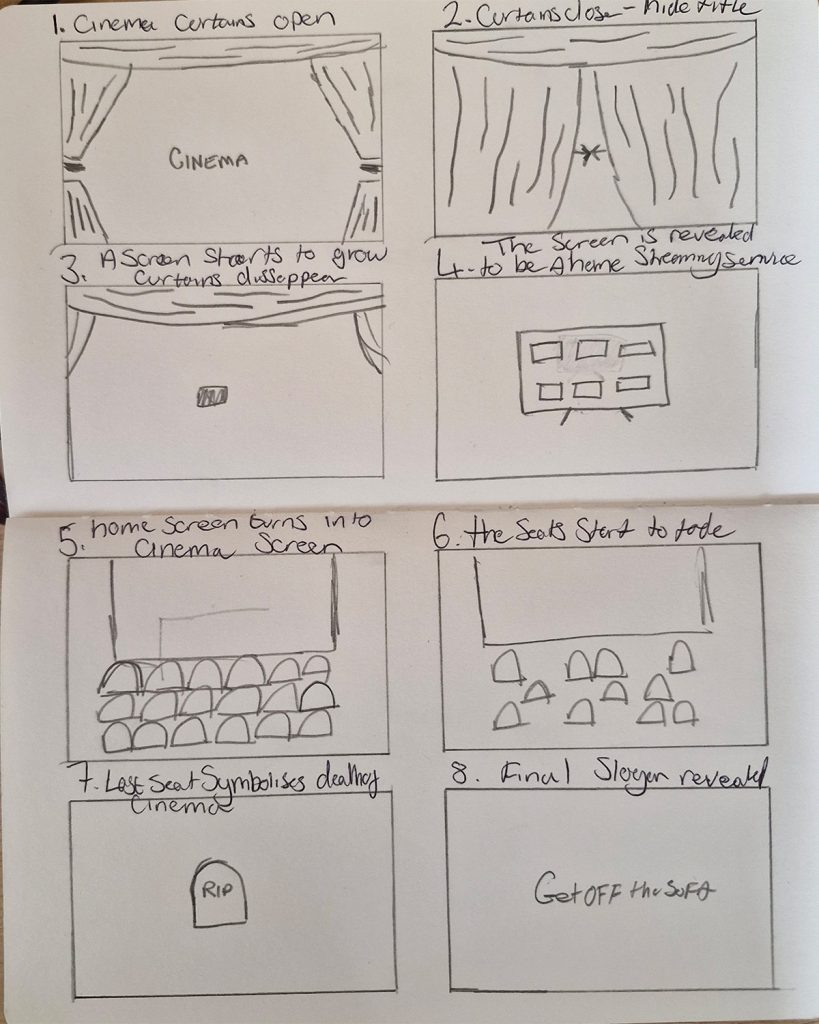
the 8 panel storyboard was a crucial step to visualising how the final animation would look and creating this early on allows a simpler process further down the line when working within the animation software. The animation starts with traditional theter/cinema curtains to set the scene and show the viewer what the video is about with typography, this moves on to the first transition with the curtains closing and revealing a screen which is growing to full size, this will symbolise the growth of thome entertainment, portraying a home screen with an abstract streaming service shown to the viewer. Following from that panel, the second transition starts and the animation shows the changing of the television screen the big cinema screen with rows of seats loading into the scene to reinforce the idea that the scene has in fact changed. I then explored even more conceptual transitions when creating the final panels, I looked into symbolism which led to the idea of using a tombstone as to signify the death of the cinema going experience, this works extremely well due to the similarities in the shape of the chair and the tombstone. Finally ending the animation with a memorable tagline.
Visual Design Treatment- How have you incorporated Edward Tufte’s five theories into your work?
Edward Tuftes theories have been incorporated into my 2D animation in various ways, one of Tuftes ideas known as ‘Chartjunk’ was especially important whilst looking at the animation as it also relates to saul bass’ title sequence work which is having a large influence on my animation approach; the way it relates is that Tufte’s term ‘chartjunk’ refers to visual elements that are irrelevant and aid no benefit to the narrative of information or persuasion, but infa add the visual clutter, this is something Bass’ does within his work and something that I have incorporated into my animation so that each illustration involved plays a specific role and acts as some form of symbolism to further push the subject.
‘it is important to incorporate design strategies which reveal detail and complexity, rather than complicate the design through clutter and confusion. One of the most powerful techniques for reducing confusion/ clutter is to use layering and separation.’ Tufte’s theory of layering and operation has also been incorporated into my work to help decrease any confusion that may arise and also help in a 2D animation as layering also allows a sense of depth to be added alongside the use of colour, this can be seen around the 20 second mark of my animation when the rows of seats are layered on top of each other, through layering and the use of colour I was able to distinguish an element of depth within the illustration style.
The animation utilises tuftes theory of space and time through the use of layout and composition on a scene paired with illustrations moving along a timeline to create a moving narrative further enhancing the story, using elements in the animation conceptually such as a living room television screen then turning to a larger cinema screen, it may not be immediately clear but as the timeline progresses and other elements enter the scene(such as the rows of seats) it become abundantly clear how timing and space play a large role in the 2D animation.
When exploring how tuftes explanation surrounding the use of colour, he makes it clear that there should be reasoning behind decision making, instead of personal preferences. ‘Ideas not only guide work, but also help defend our designs (by providing reasons for choices) against arbitrary taste preferences.'(Tufte,1990. p.82) besides the monochromatic palette, the red is used as the primary colour for the animation due to its familiarity within the cinema industry such as red carpet events, cinema curtains, usually accompanied with red cinema seats and the red and white striped popcorn boxes created a appropriate colour for the animation.
Relevant Animation History- Include at least three links to existing animation examples related to your chosen sustainable or ethical subject area and analyse them. How have they influenced your final animation?
A large influence within my 2D classical animation piece is Saul Bass and his use of colour composition and timing seen in his title sequences for some of the largest Hollywood movies, the reason I have chosen to look at Saul Bass’ work is because its some of the most influential motion graphics/animation and was revolutionary to cinema and its only fitting that an animation to save cinema is influenced by cinema. One of his works that stand out most is the title sequence for ‘its a mad mad mad mad world’ and how he uses the globe conceptually throughout the title sequence to show the opening credits, the globe works conceptually in many different ways with the circular shape being extremely interchangeable, such as the globe being used conceptually as an egg that starts to crack to reveal cast members, the globe also being unzipped and opened like a can to reveal other typography. Bass’ uses thick lines and bold imagery and minimal colours to tell a visually interesting narrative which cleverly intergrates typography, creating credits that aren’t just functional but also entertaining playing a key role in setting the movies tone.
One of Bass’s other pieces of work that stood out and influenced the 2D animation was the ‘anatomy of a murder’ title sequence, once he again Bass uses minimal colours yet still manages to capture the essence of the movie by using cut out paper styled illustrations to mimic the look of crime scene investigation murder tape. One of the interesting things that stood out to me was the choice of music which accompanied the title sequence and how the animation moved with the rhythm of the title music and how each of the parts of the body moved in sync. Looking more in-depth at the animation style used, It consists of low frames per second making the animation style quite jumpy similar to stop motion animation techniques used in early cinema history.
Another existing animation example which i looked at to influence my design decisions for my 2D animation, was the Disney Pixar’s Monsters Inc designed by Geefwee Boedoe; it has a bold and wide range of colours to appeal to the movies man target audience: children, whilst also utilising a series of abstract door illustrations to highlight one of the key elements in the movies plot, whilst also using these doors as a conceptual transition, which inspired the conceptual transition within my animation transforming the cinema seat into a gravestone depicting the death of cinema. Across all of the examples I looked at, a common theme was organic cut out shapes that feel very inline with cinema history and movie creativity, which is something I thought was important to capture in the animation.
Classical Animation Piece
References
-Motion Picture Institute, 2023. The impact of streaming services on the movie industry. [online] Social Cinema. Available at: https://motionpicture.edu/socialcinema/2023/06/19/the-impact-of-streaming-services-on-the-movie-industry/[Accessed 12 April 2025].
-FilmTrack, 2023. Streaming platforms and their impact on the film industry. [online] FilmTrack Blog. Available at: https://blog.filmtrack.com/industry-insights/streaming-platforms-and-their-impact-on-the-film-industry [Accessed 12 April 2025].
-The Hollywood News, 2025. The impact of streaming services on traditional cinema. [online] The Hollywood News. Available at: https://thehollywoodnews.com/2025/01/10/the-impact-of-streaming-services-on-traditional-cinema/[Accessed 12 April 2025].
-Adobe Stock, n.d. Audio track: 526744220. [online] Adobe Stock. Available at: https://stock.adobe.com/uk/search/audio?k=526744220 [Accessed 29 April 2025].
-Starburst Magazine, 2023. The rise of streaming services: how they are changing the film industry. [online] Starburst Magazine. Available at: https://www.starburstmagazine.com/features/the-rise-of-streaming-services-how-they-are-changing-the-film-industry/ [Accessed 29 April 2025].
-Art of the Title, n.d. It’s a Mad, Mad, Mad, Mad World (1963). [online] Art of the Title. Available at: https://www.artofthetitle.com/title/its-a-mad-mad-mad-mad-world/ [Accessed 29 April 2025].
-Vysotska, Y. (2019) Layering and separation. Medium. Available at: https://medium.com/@vys77/layering-and-seperation-d4122a6952ce (Accessed: 1 May 2025).
-Art of the Title (n.d.) Monsters, Inc. (2001). Available at: https://www.artofthetitle.com/title/monsters-inc/ (Accessed: 1 May 2025).
-Tufte, E.R. (1990) Envisioning information. Cheshire, CT: Graphics Press.
