Production Piece & Portfolio
During my proposal stage I identified that the direction of the production piece would be looking at how emerging technologies can be tailored to graphic design, combining new technologies with core design principles and practices; Lustrum: The Last Five years does this by using a traditional printed magazine created using layout software inDesign whilst pairing the concept with 8th wall augmented reality features to bring printed stories and articles to life by viewing from a printed media from a new perspective.
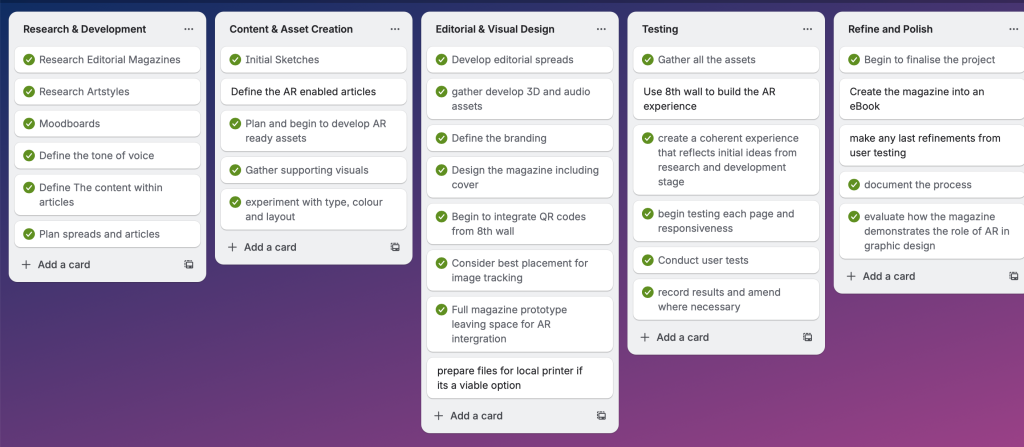
One of the most important things that was created during the proposal stage was the Trello mood board which allowed me to track weekly deadlines and schedules, this allowed time towards the end of the production piece to test, fix and improve any of the features within the experience, the weekly progress tracking also allowed me ensure that I had sufficient time to plan, design and create the magazine and send it off to print over the festive period.
The first step taken that was determined within the proposal stage was the research and development stage, this was primarily done using Figjam to create a mood board and begin to look at other material which would help to determine the look and feel of the magazine along with helping to determine what each spread will include on the print swell as what augmented reality experience it will pair with. The printed articles initially consisted of: The front Cover, Contents and AR instructions page, Black British Music(An Overview), Artist Showcase, Black British Music, The Grime Generation.
Using each page as a potential image target for tracking, meaning that when designing each layout I had to ensure there was limited blank/white space, high contrast and distinctiveness so that they would be easily recognised by the 8th wall AR system as the correct image taste for the corresponding experience.
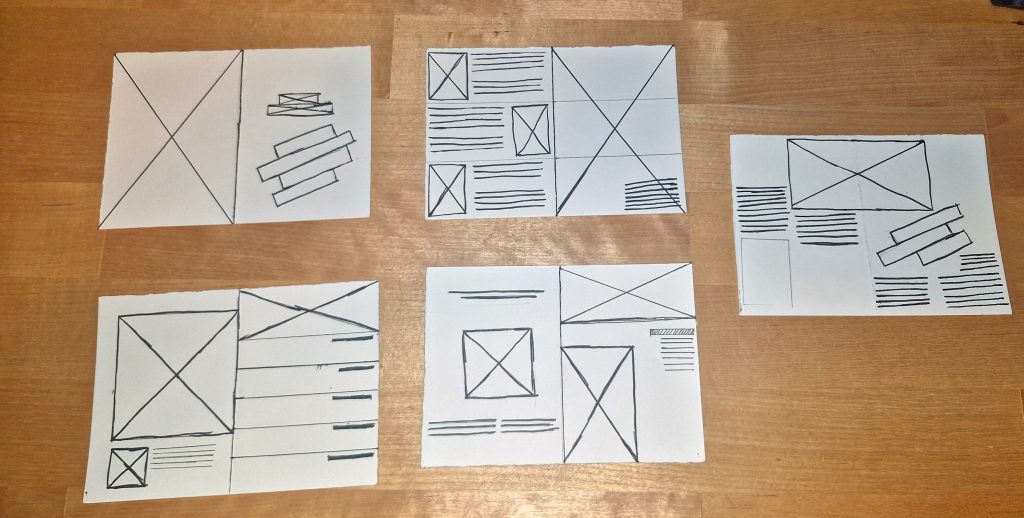
After completing the research and development stage, I began the process of creating the magazine. The first step following research was to develop sketches for each spread, which allowed me to determine the content layout, hierarchy, and key elements for every page. This planning stage was essential for ensuring that both the print and AR components could coexist seamlessly. I then compiled a series of high-contrast, high-quality images and used ChatGPT to generate the copy for each article, ensuring that all textual and visual assets were ready for use. Additionally, a collection of quotes from Black British music artists was created in Illustrator, providing further cultural context and visual interest for the spreads.
Throughout the design process, careful attention was paid to the use of imagery and typography. Bold, powerful visuals were paired with thoughtfully chosen typefaces to reinforce the magazine’s tone of voice and the individuality of each article. This attention to detail was critical in creating a cohesive identity that would extend into the AR experience, where the digital layers build upon the same visual language. The combination of strong editorial design and AR features was intended to offer readers a fully immersive and interactive experience.
With all static assets prepared, I was able to assemble a 12-page, five-column magazine, featuring concise and engaging articles, relevant imagery, and a clear contents page. Special care was taken to include explicit directions on how to enter the AR journey, ensuring that the transition from print to digital was intuitive and user-friendly. Once the magazine layout was finalised, it was prepared for print, with the 8th Wall project file already configured to link the embedded QR code to the correct AR experience. This careful preparation ensured a streamlined, cohesive experience that integrated both physical and digital interactions from the moment the reader picked up the magazine, once again reinforcing the goal of the proposal – to combine traditional practices with emerging technologies.
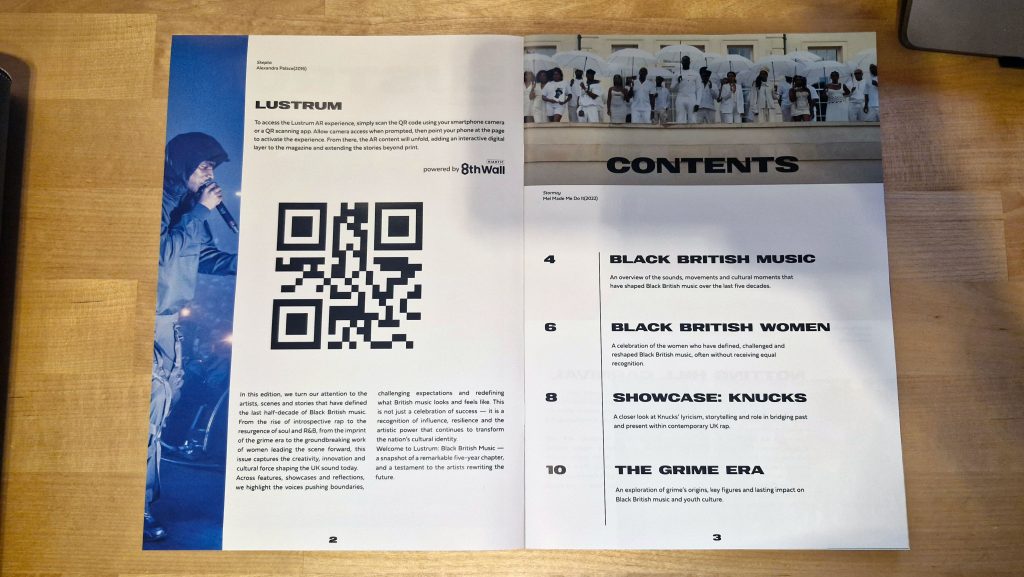
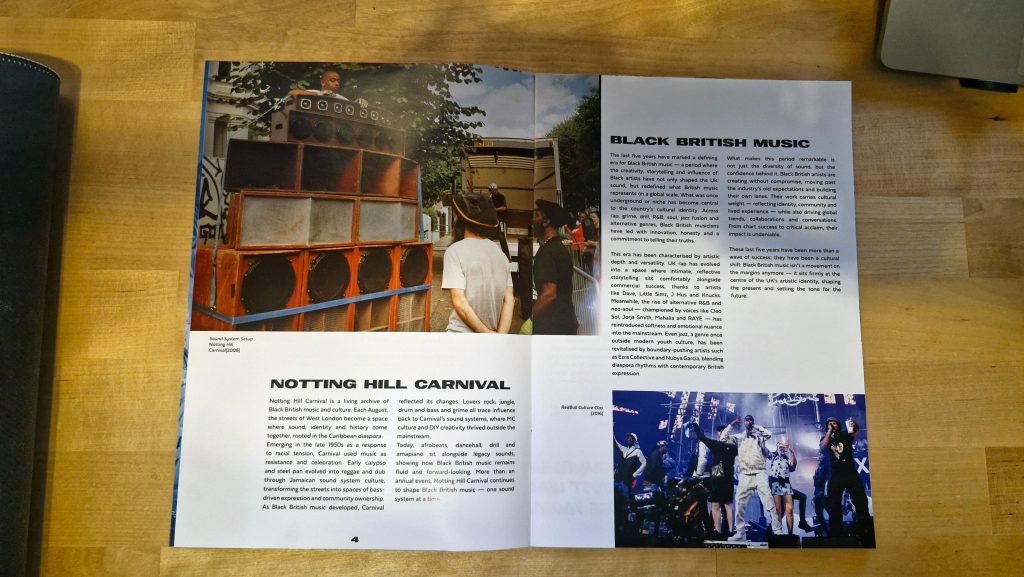
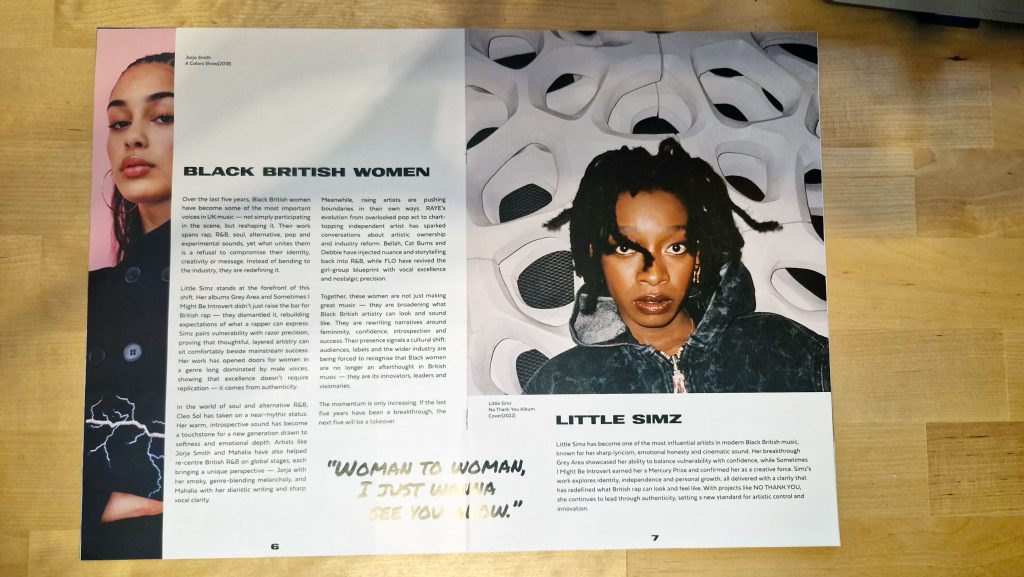
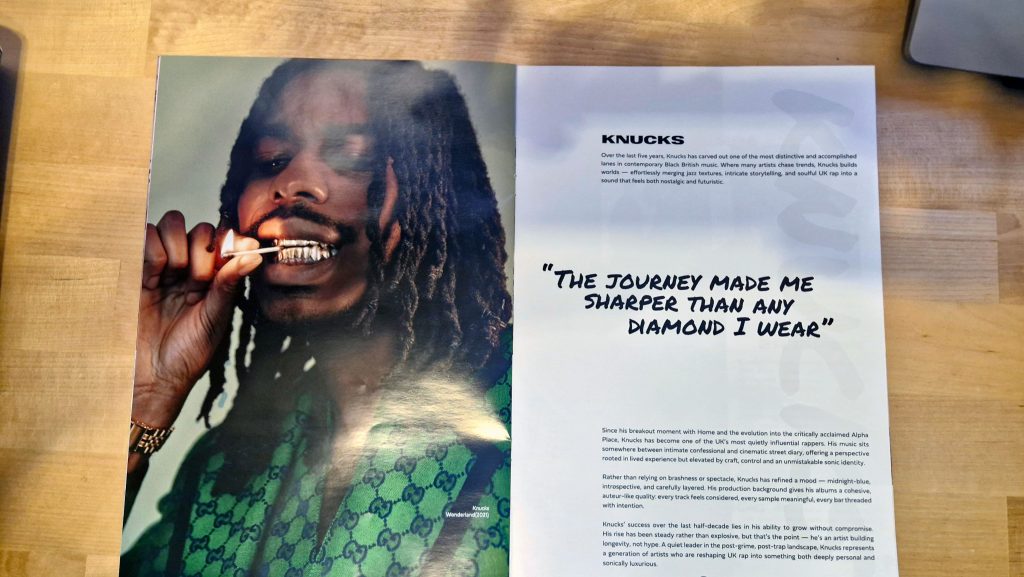
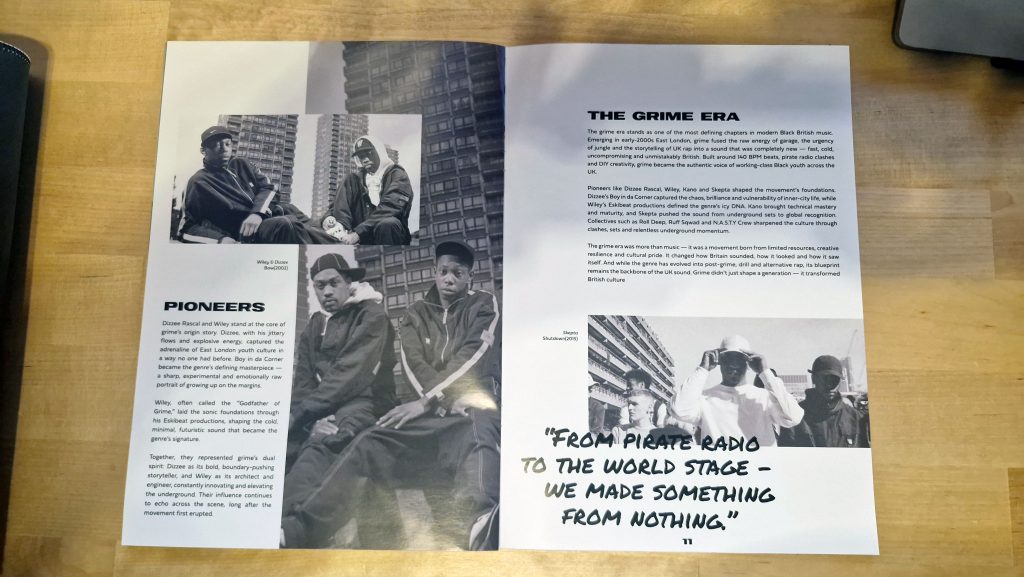
One of the things I wanted to include within the AR experience was an option for audio, where I could showcase artists music, music videos(YouTube) and also an option for the articles to have audio narration, this would only add an additional dimension to the magazine and AR experience but would help with accessibility, allowing visual impaired users to listen to the articles; doing all these things would further support the goal of the proposal which was to bridge the gap between traditional graphic design practices and emerging technologies.
The direction which was taken with the audio narration was carefully considered and I wanted to take the experience to the next level, one of the ways that it was elevated was through the use of AI, I used Artlist.com, an AI service used to create text to speech audio files which I could then use within the AR journey allowing each page to narrate what is written. This was further explored by cloning black British artist voices and using artlist to emulate them speaking different sections of the magazine which most represented themselves. The voice cloned audio narrations were used as follows:
- Little Simz being one of the biggest artists in the black British music scene to read the intro on the first page, an introduction to the magazine.
- The first article(Black British Music: an Overview) is a voice clone of Stormzy, who has lead the the forefront of black British music in recent years.
- For the Women in music article, I re-used Little Simz’ voice due to her being one of the main focuses of the article.
- The Knucks: Artist showcase spread uses Knucks voice to narrate the text.
- The last spread about pioneers and the grime era features 2 of the biggest artists from the grime genre: Skepta and Chip to narrate, Skepta being pictured and named in the right hand page.
One of the key ways the augmented reality experience was elevated was through the considered use of 3D models, which were either sourced from existing 3D model libraries or modelled and textured independently using Blender. These models were not included purely for visual enhancement, but were instead designed to reinforce the themes and narratives of the accompanying articles. For the article exploring The Grime Era, a 3D microphone model was created to act as a symbolic representation of MC culture, pirate radio, and early grime sets. While microphones are commonly associated with music more broadly, in this context the model functions as a specific cultural reference, grounding the AR interaction in the history and practices of grime music. The model is further supported by surrounding 3D typography featuring selected lyrics from Skepta’s Shutdown, adding an additional layer of meaning and reinforcing the connection between the physical magazine and the digital overlay.
For the article focusing on the artist Little Simz, a different approach to 3D modelling was taken. The image tracking is anchored to the main article image, which features Little Simz’s album No Thank You. When scanned, the AR experience reveals a series of 3D models created in Blender that represent a selection of her other albums, presented as record sleeves. This creates a sense of expansion beyond the printed page, allowing the AR layer to visually reference the artist’s wider body of work. The use of 3D objects in this way encourages exploration and provides additional context without overwhelming the user, enhancing engagement while remaining thematically relevant.
A further 3D model was incorporated into the Notting Hill Carnival article. This model was sourced from an online 3D asset library and paired with custom 3D typography designed to reflect the tone of voice and visual identity of the magazine. Across all AR interactions, the same typographic style is used for the 3D text elements as that used for the magazine title and article headings. This consistency strengthens the cohesion between print and digital components, ensuring the augmented elements feel like a natural extension of the editorial design rather than a separate or disconnected feature. As a result, the AR experience operates as a fully integrated production piece, where 3D modelling and typography work together to enhance narrative, reinforce cultural context, and maintain a unified visual language.
Once all assets had been finalised, including the printed magazine, digital pages for image tracking, audio narration files, and 3D models, the experience was built within 8th Wall. A previously created project was used to ensure the printed QR code correctly linked to the intended 8th Wall environment, allowing for a seamless transition from physical to digital. Using 8th Wall’s image tracking functionality, audio and 3D models were successfully anchored to selected pages, enabling the AR content to respond directly to the printed material.
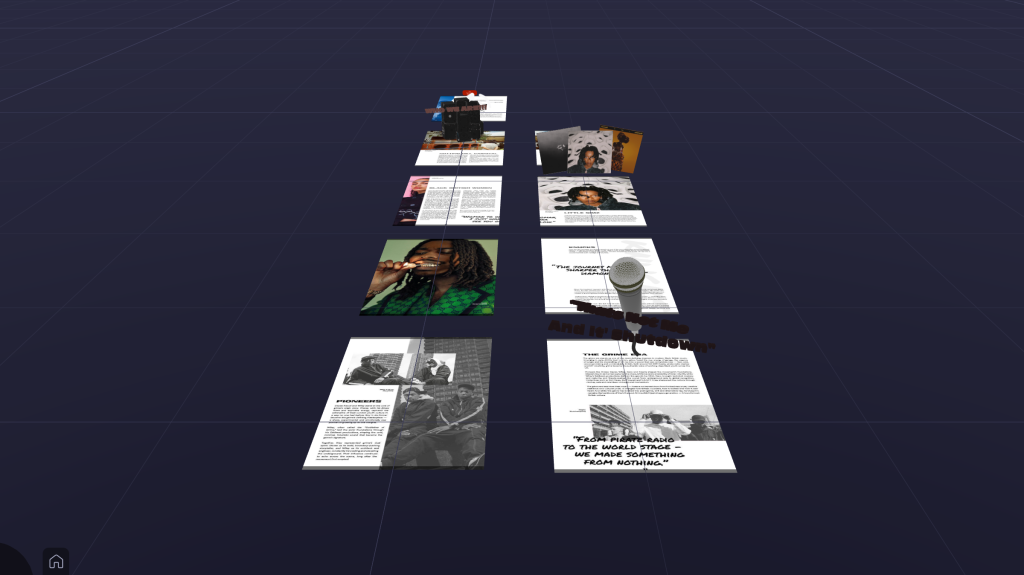
However, limitations within 8th Wall Studio influenced how the experience could be implemented. The initial intention was for each page to trigger its own narrated audio session corresponding to the written copy. This approach proved unworkable, as multiple audio files would play simultaneously when different pages were recognised, resulting in an overwhelming and unclear user experience. To resolve this, all narration files were combined into a single continuous audio track using Adobe Premiere. This long-form audio was then triggered on the first AR page and played through sequentially, allowing the narration to progress in alignment with the order of the magazine pages rather than being activated individually.
While this solution enabled the inclusion of audio narration, it introduced further constraints. Due to the current capabilities of 8th Wall Studio, audio controls such as pause and play were not available without implementing custom code. As a result, the narration plays as a single uninterrupted sequence, limiting user control over playback. Additionally, an intended feature involving the activation of a video element when the ‘Knucks’ imagery was scanned, either through an embedded MP4 file or a linked YouTube video showcasing a recent music release, could not be implemented. This was again due to the restrictions of the no-code version of 8th Wall Studio. These limitations ultimately shaped the final AR experience, highlighting the balance between creative intention and the practical constraints of the chosen platform.
Some of the ethical values and principles considered and embedded within the experience centre around user-centred design and accessibility. Clear instructions on how to enter the AR experience are provided through the printed material, ensuring users are guided from the outset without confusion or unnecessary friction. Once within the experience, a clear call-to-action button leads directly to the audio narration, allowing users to engage with the content immediately while maintaining control over how they interact with the AR elements. This approach supports a low-effort entry point and enables users to explore the 3D content at their own pace, without feeling rushed or overwhelmed.
The inclusion of audio narration plays a key role in improving accessibility within the AR experience. By offering an alternative to on-screen text, the narration allows users with visual impairments to engage with the articles through listening, a feature more commonly associated with traditional web-based content. In the context of AR, this extends access beyond visual interaction alone. Additionally, the audio option supports hands-free engagement, making the experience more adaptable to different environments and use cases. It also caters to auditory learners who may struggle with prolonged reading, helping to maintain engagement while ensuring the experience remains inclusive and considerate of varied user needs.
Final Production Experience
Final Portfolio – Narrated Video
References
Vogue (n.d.) Little Simz interview. Available at: https://www.vogue.co.uk/arts-and-lifestyle/article/little-simz-interview (Accessed: 3 December 2025).
Harper’s Bazaar Australia (n.d.) Little Simz interview. Available at: https://harpersbazaar.com.au/little-simz-interview/ (Accessed: 6 December 2025).
WYSO (2023) Rap virtuoso Little Simz says “No Thank You” to exploitive record companies on her new album. Available at: https://www.wyso.org/arts-culture/2023-04-26/rap-virtuoso-little-simz-says-no-thank-you-to-exploitive-record-companies-on-her-new-album (Accessed: 14 December 2025).
New Statesman (2018) Grime books: Inner City Pressure reviewed. Available at: https://www.newstatesman.com/culture/books/2018/09/grime-books-inner-city-pressure-dan-hancox-kids-inside-story-global-takeover-dj-target-review (Accessed: 9 December 2025).
Wonderland Magazine (2021) Knucks: Spring 21 issue. Available at: https://www.wonderlandmagazine.com/2021/05/19/knucks-spring-21-issue/ (Accessed: 17 December 2025).
Pin-Up Magazine Archive (n.d.) Interview: Dan Hancox on grime, architecture and Inner City Pressure. Available at: https://archive.pinupmagazine.org/articles/interview-author-dan-hancox-inner-city-pressure-grime-and-architecture-wot-do-u-call-it-urban (Accessed: 11 December 2025).
Red Bull Music Academy (2016) Photo mixtape: Grime. Available at: https://daily.redbullmusicacademy.com/2016/05/photo-mixtape-grime (Accessed: 5 December 2025).
BBC Newsbeat (2022) Stormzy Mel interview. Available at: https://www.bbc.com/news/newsbeat-63010712(Accessed: 18 December 2025).
Vice (n.d.) Nostalgic photos of Black British music scenes. Available at: https://www.vice.com/en/article/eddie-otchere-nostalgic-photos-black-british-music-scenes/ (Accessed: 7 December 2025).
Clash Magazine (n.d.) Live report: Skepta at Alexandra Palace. Available at: https://www.clashmusic.com/live/live-report-skepta-alexandra-palace/ (Accessed: 16 December 2025).
Red Bull (n.d.) Red Bull Culture Clash rules. Available at: https://www.redbull.com/au-en/red-bull-culture-clash-rules (Accessed: 2 December 2025).
Sketchfab (n.d.) Sound system 3D model. Available at: https://sketchfab.com/3d-models/sound-system-b9d0a5b414f74d688910f2b8bfcfc8e25 (Accessed: 20 December 2025).
